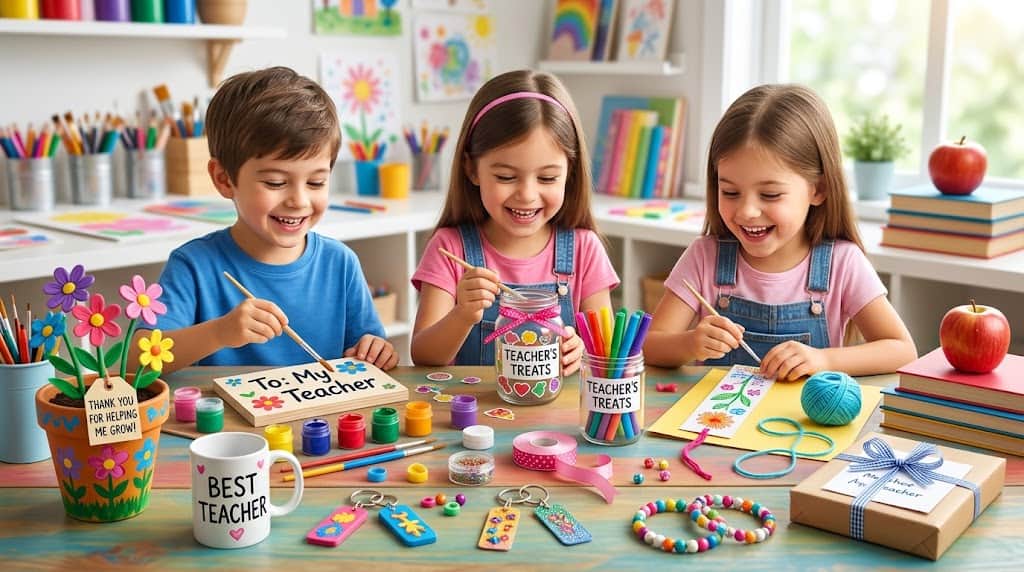
DIY Teacher Appreciation Gifts Kids Can Help Make
By Jenna Calloway | May 2026
My daughter Lily came home from second grade one afternoon in early May with a very serious look on her face. She dropped her backpack at the door, sat down at the kitchen table, and announced without any preamble: “Mom. We need to make something for Miss Harmon.”
Not buy. Make.
I asked her why making was important. She thought about it for a second and said, “Because Miss Harmon always makes things for us. She makes our classroom pretty. She makes us feel good when we have a bad day. She made me a bookmark when I forgot mine.” She paused. “So we have to make something back.”
I didn’t have a good argument against that. She was seven and she had figured out something that takes most adults years to understand: the value of handmade is not in the object. It’s in the effort. It’s in the choosing to spend your time and your hands on someone else’s happiness.
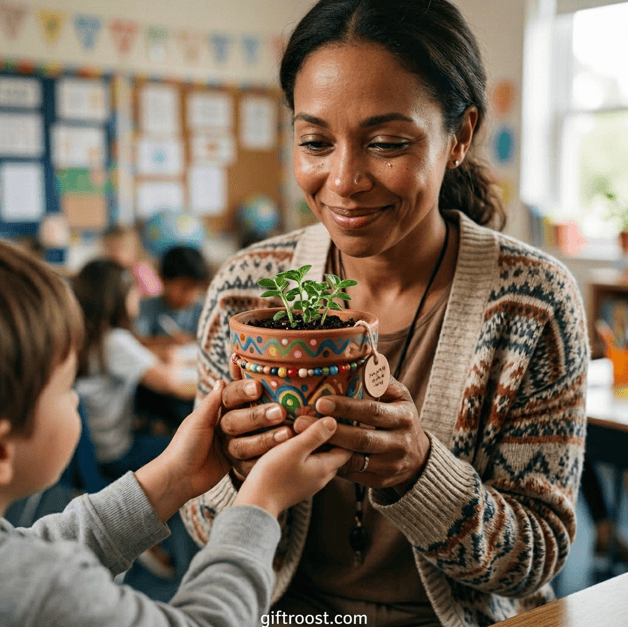
We spent that Saturday afternoon making Miss Harmon a small decorated plant pot filled with herbs, with a handwritten tag that said “Thanks for helping me grow.” Lily painted the pot herself — crooked stripes, a lopsided sun, her name in big wobbly letters on the back. It was not Pinterest-perfect. It was better than that. It was completely, unmistakably hers.
When Miss Harmon received it at the end of the week, she held it with both hands and told Lily it was going to live on her desk for the rest of the school year. She meant it. Lily glowed for days.
That experience is what this article is built on. Not the idea of impressive teacher gifts, but the understanding that teachers receive a lot of gifts — and the ones they remember, the ones they keep, the ones they talk about years later — are almost always the ones made by little hands with genuine intention behind them.
These DIY teacher appreciation gift ideas are real. They’re doable with kids from age three upward. They don’t require craft supplies you don’t already own. And they carry the one ingredient that no store-bought gift can replicate: proof that a child cared enough to make something.
Why Teachers Remember Handmade Gifts More Than Anything Else
Before we get into the ideas, I want to say something that I think often gets lost in the conversation about teacher gifts. Teachers are not hard to please. They are, almost universally, people who went into a profession that pays less than it should because they genuinely love children and genuinely believe that helping young people learn is among the most important work a person can do. These are not people who are waiting to be impressed by expensive gifts.
What they do wait for — what they keep on their desks and take home at the end of the school year and mention in retirement speeches — are the small handmade things that show a child was thinking about them. The note in a child’s own handwriting. The drawing that tried very hard to look like something. The gift that clearly took time and care and small sticky fingers to create.
I’ve spoken to teachers about this more times than I can count, and the answer is always the same: the gift I still have is the one the kid made. The potted plant. The hand-stamped card. The little book of drawings. The jar of “reasons you’re my favorite teacher” on folded pieces of paper. These things get kept because they are evidence of being loved by a child, and that is not a small thing to anyone who has chosen to spend their life with children.
So as you go through these ideas, please set aside any concern about whether your child’s contribution is neat or skilled or polished. The wobbliness is the point. The imperfect handwriting is the point. The visible effort of a small person trying their best for someone they admire — that is the entire gift.
1. The “You Helped Me Grow” Herb Planter
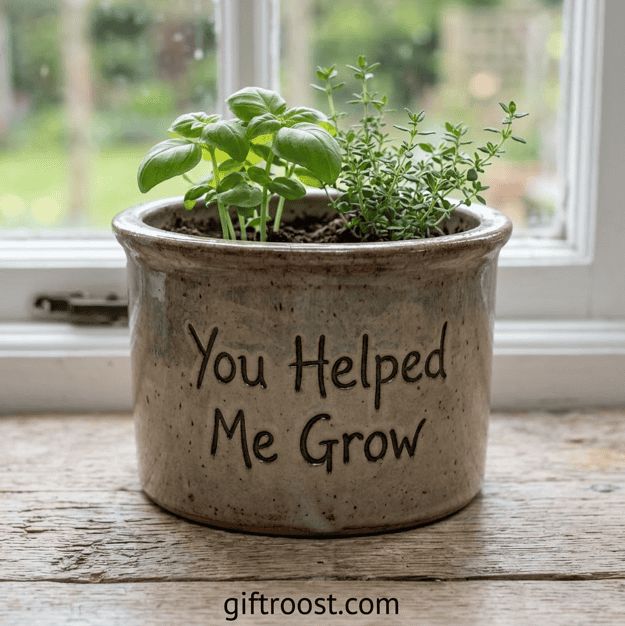
This is the one Lily made for Miss Harmon, and I’ve recommended it to every parent I know since then. It works beautifully, it’s genuinely useful for the teacher, and it gives kids a meaningful role in every single step of the process.
You need a small terracotta pot, some acrylic craft paint, a permanent marker, potting soil, and a small herb plant — basil, mint, rosemary, or thyme all work well and are widely available at grocery stores and garden centers for just a few dollars. The total cost is typically under five dollars, often less if you have paint at home.
The process is the gift. Your child paints the pot however they want — stripes, dots, flowers, their teacher’s name, a favorite color — while you help them write a small tag. The classic version reads “Thanks for helping me grow,” but Lily’s said “You make school feel like home,” which I liked even better. Whatever your child wants to say, write it in pencil first and let them trace it in marker, or write it yourself in their dictated words.
Plant the herb, let the paint dry fully, and present it wrapped in tissue paper in a small gift bag. The result looks genuinely thoughtful and is genuinely useful — most teachers love having something living on their desk — and your child has touched every part of it. That matters.
If your child is older — eight or nine and up — let them research which herb might suit their teacher’s personality. A teacher who always has coffee on her desk might love a mint plant for tea. A teacher who loves to cook might appreciate fresh basil. The research is a small exercise in paying attention to someone else, which is its own kind of lesson worth teaching.
DIY Teacher Appreciation Gifts Kids Can Help Make
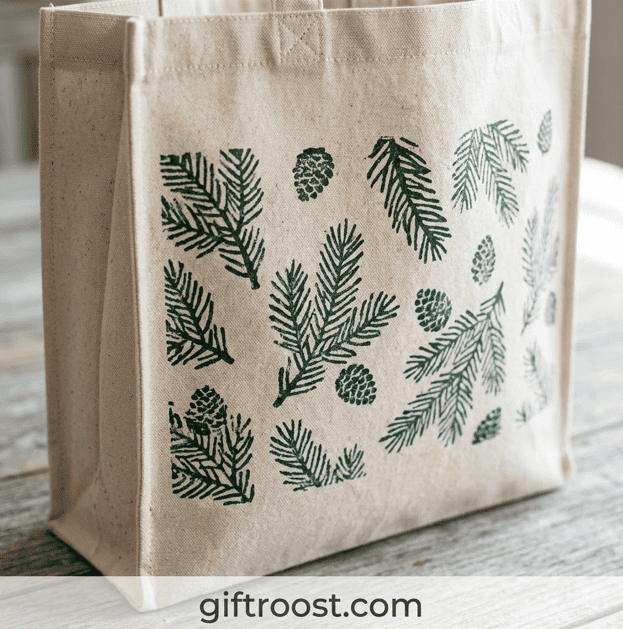
2. A Hand-Stamped Tote Bag
Teachers carry things. A lot of things. Books, papers, folders, supplies, snacks they bring from home because they often don’t have time for a proper lunch. A sturdy, personalized tote bag is something a teacher will use every single week — and if it was decorated by a child who thinks they hung the moon, it becomes something she’ll reach for specifically because of what it represents.
Plain canvas tote bags are available at most craft stores and online for two to four dollars. For stamping, you can use store-bought foam stamps, cut shapes from a potato or a sponge, or simply use the tools you have: the bottom of a bottle cap, a fork dipped in paint, a crumpled piece of foil. The results of unpredictable stamping are often more charming than the precisely planned kind.
Set up a small workspace with fabric paint — regular acrylic will work on canvas but fabric paint is more permanent — and let your child go. Some children will have a clear vision of what they want to create. Others will need gentle guidance: “What’s your teacher’s favorite color?” “What about flowers, or stars, or her name?” Give them as much ownership as they can handle, and supplement where needed.
For older children, you can add a handwritten or stamped message on the inside lining of the bag, or tie a small handwritten card to the handles. “Everything you carry matters. Thank you for carrying us too.” Or something simpler: just their name, the year, and a small heart.
Let the paint cure for at least 24 hours before presenting. If you can, iron the painted areas briefly with a cloth between the iron and the paint — this sets fabric paint and makes it more washable. Small practical detail, big difference in longevity.
DIY Teacher Appreciation Gifts Kids Can Help Make
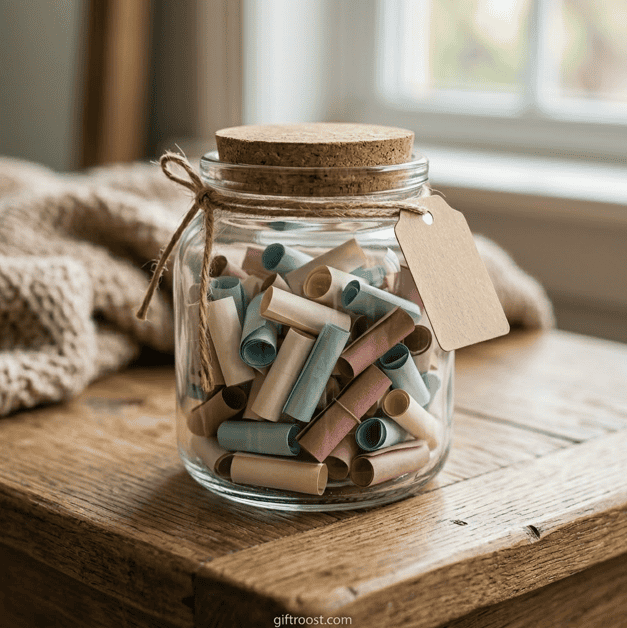
3. A “Things I Love About You” Jar
I’m going to tell you right now that this one will make a teacher cry. Not in a sad way. In the way that happens when someone receives more love than they were expecting on an ordinary Tuesday.
Take a clean glass jar — a mason jar, an old pasta sauce jar with the label removed, anything with a lid. Decorate the outside with ribbon, washi tape, stickers, or your child’s drawings on a paper label glued to the front. Then fill it with small folded pieces of paper, each one bearing something your child loves, admires, or appreciates about their teacher.
This is where you sit down with your child and have a real conversation. Not a performance, not a dictation — a genuine question session. “What does your teacher do that helps you?” “What’s something she says that makes you feel good?” “What’s your favorite thing about being in her class?” “What do you think she works really hard at?” “What would school be like without her?”
Write down what your child says in their words, not cleaned-up adult versions. The child who says “She always knows when I’m sad and she doesn’t make it weird” is saying something more true and more beautiful than any greeting card has ever managed. The child who says “She smells like coffee but it’s a nice smell” is being honest in a way that will make the teacher laugh and then cry and then laugh again.
Aim for ten to twenty slips depending on your child’s age and enthusiasm. Fold each one, put them all in the jar, seal it with a bow, and include a small tag that says “Open one whenever you need a reminder.”
4. A Handprint Keepsake Artwork
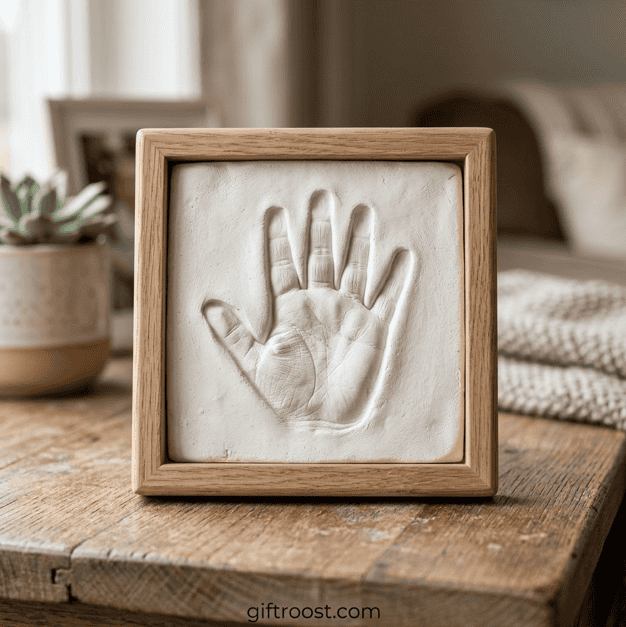
Handprint art has been around forever in elementary school classrooms, and the reason it endures is because it genuinely works. A child’s handprint is a record of a specific moment in time — a size, a shape, a smallness that will never exist again once the child has grown. Teachers know this. Parents know this. And anyone who has received a piece of handprint art from a child they love understands immediately why it goes up on the wall and stays there.
The most classic version is a simple painted handprint on quality cardstock with the child’s name and date written beneath it. But there are more elaborate versions that are worth the small extra effort. A tree made from a brown handprint trunk with green fingerprint leaves and a message written across the bottom. A bouquet of flowers made from painted thumbprints on stems drawn in marker. An ocean scene where the handprint becomes a wave. A butterfly made from two symmetrical handprints pressed together at the wrist.
For Teacher Appreciation specifically, consider a version that incorporates a message into the design. The handprint becomes a flower, and across the top: “Thank you for helping this grow.” Or the child’s handprint is placed beside a smaller second-grade ruler, and the note reads: “You’ve helped me measure how far I’ve come.” The concept doesn’t have to be elaborate — it just has to be true.
Frame the finished piece in a simple inexpensive frame. The frame matters more than people think — it signals that this is art worth displaying, not just a piece of paper. A framed child’s handprint painting is something many teachers keep for the rest of their careers.
5. A Batch of Something Baked and Beautifully Packaged
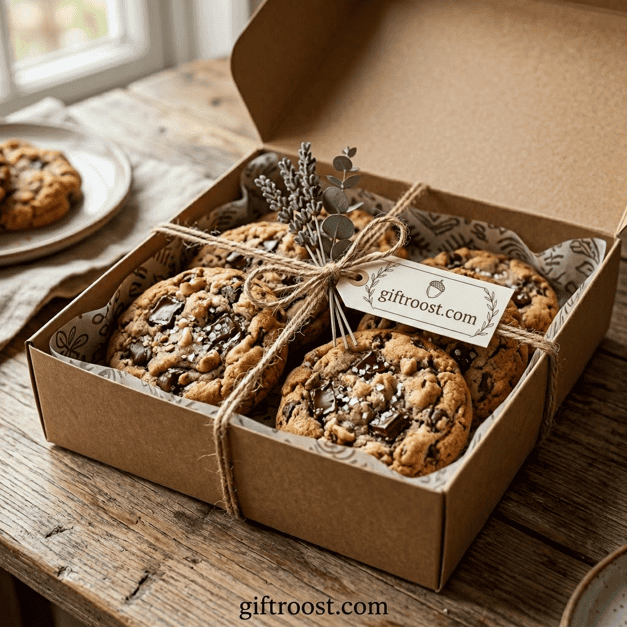
Let’s be practical here for a moment. Some children are not the sit-down-and-paint type. Some children express love through activity, through helping, through doing something that feels productive. For those children — and for the parents who know their child best — baking is the perfect love language.
The gift is not just the cookies or the brownies or the banana bread. The gift is the involvement of the child at every stage. They measure the flour. They crack the egg (and you quietly fish out the shell while they’re not looking). They stir until they get tired and hand off the spoon. They press the cookie cutter down and pick up the shapes with great seriousness. They choose the sprinkles. They are, in their own mind, entirely responsible for this creation.
The packaging is where the gift becomes something beyond a baked good. Don’t put the cookies in a zip-lock bag. Line a small box with parchment paper and tissue. Tie it with ribbon. Attach a handwritten tag from your child. If they can write, let them write it. If they can’t yet, let them dictate: “I made these for you.” “These are chocolate chip because you like chocolate.” “I hope they taste good. I put in extra love.” (Lily’s exact words, used twice now, both times resulting in teacher tears.)
Check on allergies and school policies before sending food. If in doubt, opt for pre-packaged treats that you’ve decorated the packaging of, rather than home-baked. The presentation and the personal note are what carry the sentiment.
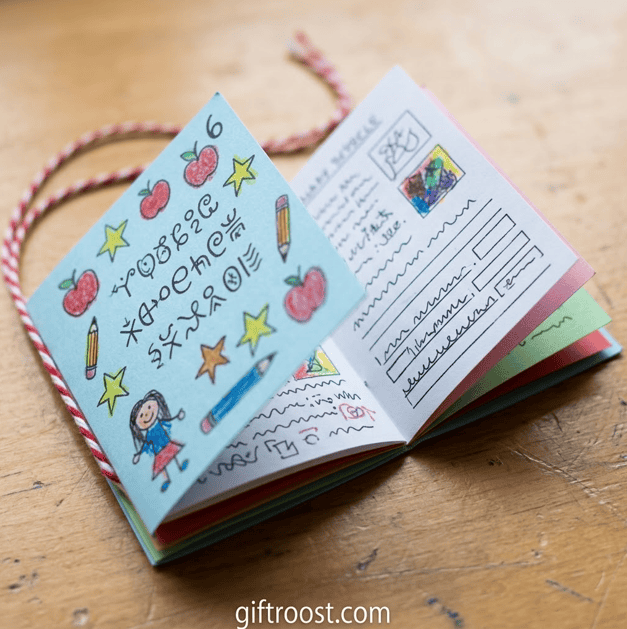
6. A “Book About My Teacher” Mini Booklet
This one requires a little more preparation time but produces something genuinely unlike any other gift a teacher will receive, and it has an almost unfair ability to make people emotional.
The concept: your child creates a small booklet about their teacher. You fold five or six sheets of printer paper in half and staple the spine — instant booklet. Your child decorates the cover: the teacher’s name, a drawing of what their teacher looks like, the school year. Then, on each page, a prompt that your child fills in however they choose.
The prompts can be simple: “My teacher’s name is ___.” “She has ___ hair and ___ eyes.” “Her classroom smells like ___.” “The thing I love most about school is ___.” “My teacher is really good at ___.” “She always says ___.” “I think after school my teacher probably ___.” “The best thing she ever taught me was ___.” “My teacher is special because ___.”
That last one — “I think after school my teacher probably ___” — is where the gold is. Children have extraordinary theories about what their teachers do when they’re not at school. “She goes home and reads all the books.” “She probably has five cats.” “She watches movies about history because she loves it so much.” These answers are so honest and so sweet and so specifically a child’s view of the world that teachers tend to read them multiple times and share them with everyone they know.
Help with the writing as much as your child needs. Let their answers stay their answers. The imperfect spelling is part of what makes it real.
 Save
Save
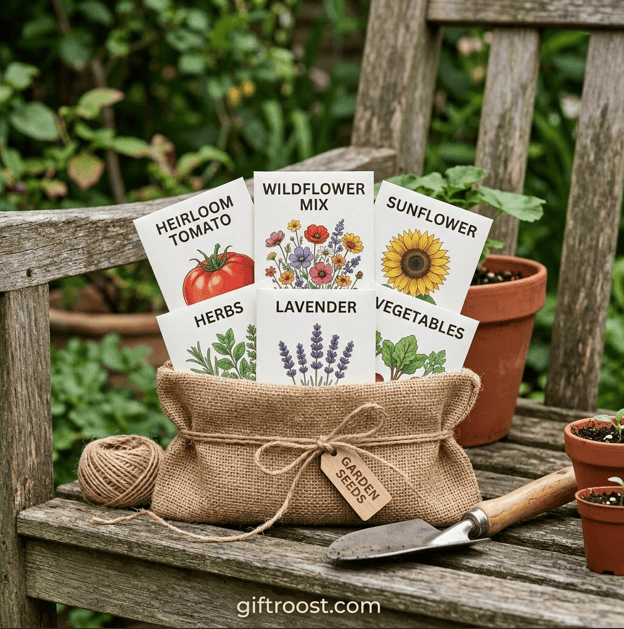
7. A Seed Packet Garden Gift Set
This is a lovely gift for the teacher who has mentioned anything even vaguely plant-related during the school year — who has a plant on her windowsill, who did a lesson on how seeds grow, who mentioned having a garden at home, who just seems like the kind of person who would enjoy watching something living and growing.
You buy two or three packets of easy-to-grow seeds — sunflowers, marigolds, herbs, sweet peas, anything cheerful and not too demanding. Your child decorates a small paper bag or box to hold them. They make a handmade card. If they’re old enough, they might write a note about what each plant is and how to grow it, which requires a little research and feels wonderfully purposeful for a child who likes to know things.
The presentation matters. Don’t hand over the seed packets in their original plastic wrapping. Arrange them with a small tag, maybe a little terracotta pot if you have one, maybe a pair of small gardening gloves. Wrap the whole thing in tissue in a gift bag. The effort of presentation communicates something important: this was assembled by someone who wanted it to be received beautifully.
You can also make this gift uniquely personal by growing a few seedlings at home and giving the teacher a plant that’s already been started. If your child has helped water and tend the seedling for a week before Teacher Appreciation, the connection to the gift deepens. “I grew this for you” is a different thing from “I bought this for you,” and children who have watched a seedling grow under their care understand that difference in a way that is both simple and profound.
8. A Class Photo Memory Frame
At the end of the school year, a teacher says goodbye to a group of children she has spent nearly every weekday with for nine or ten months. She has watched them grow. She knows which one chews their pencil, which one needs the window seat, which one needs ten minutes to warm up in the morning and which one comes in at full speed. She knows their handwriting and their laughs and the specific way each one of them asks for help.
And then they leave. New class next year. Different faces, different names, different small personalities to learn all over again. The previous year’s class becomes a memory, and without a tangible record, those memories fade faster than any teacher wants them to.
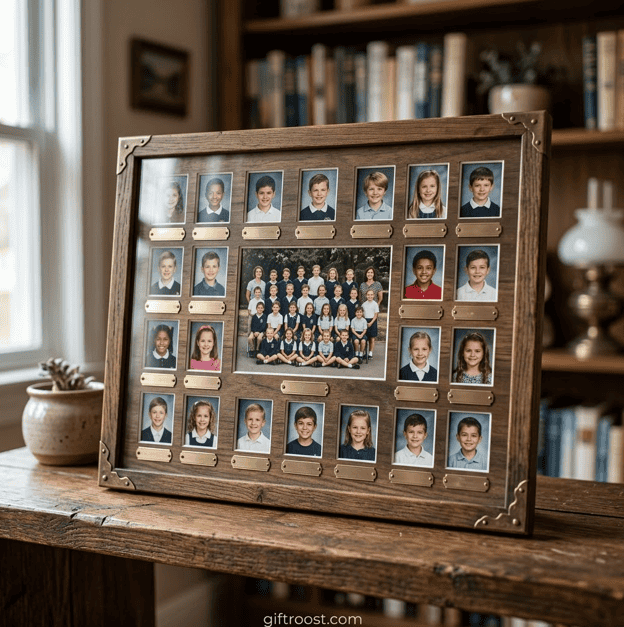
A class photo in a decorated frame is a gift that captures the year. You can make this individually — a photo of your child with their teacher, framed in a frame your child has decorated with paint, stickers, washi tape, or a collage of small drawings. Or, if you’re organizing something for the whole class, you might collect a group photo and work with a few parent volunteers to have it printed large and framed beautifully, with every child’s signature on the matte around it.
The individual version is accessible, affordable, and completely manageable to do solo. Buy a plain wooden frame from a craft store for a dollar or two. Let your child paint it, decorate it, cover it in their fingerprints in favorite colors, write their name on the back. Print a good photo — not just a phone snapshot, but a properly printed photograph from a pharmacy or print shop. The result is something a teacher can display in her classroom or take home, and something your child is genuinely proud to have made.
9. A Homemade Stress Relief Gift Set
Here is a gift idea that requires you to hold two truths at once: children believe their teacher has a magical and almost effortless life, while adults know the reality. Teaching is one of the most emotionally demanding jobs that exists. Teachers absorb the stress of thirty families, navigate the behavioral and emotional needs of dozens of children simultaneously, plan and assess and communicate and manage — all while performing at their best for six or seven hours a day in front of an audience that is entirely dependent on them.
A handmade “self-care” gift set acknowledges both the child’s love and the adult’s need. And when it’s made and assembled by a child, it carries a sweetness that a store-bought spa kit could never have.
The components are simple: a small candle (store-bought but given a handmade label your child decorated), a packet of herbal tea in a little illustrated envelope, a bath soak in a small jar with a sticker label, a handwritten “you deserve a break” note from your child. Or simpler still: a clean jar filled with Epsom salts your child has scooped and measured themselves, labeled with “Relaxing Salts — made by ___.” Tie the components together in a small basket or wrap them in tissue and a gift bag.
The child’s note is the most important piece of any iteration of this gift. Let them say whatever they want to say: “You work really hard.” “I hope you get to rest this weekend.” “Thank you for being patient with me when I was difficult.” (That last one, unsolicited and unscripted, from a nine-year-old boy I know, brought his teacher to tears and was mentioned at his fifth-grade graduation.)

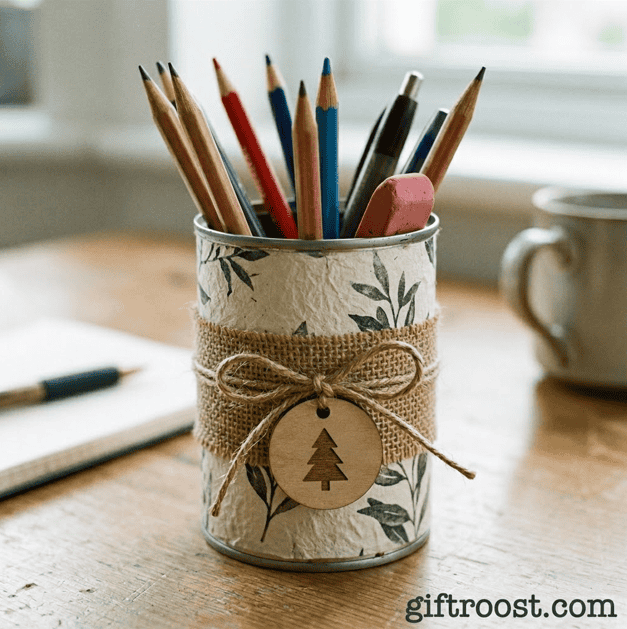
10. A Personalized Pencil Holder Made from a Can
This is the one for the youngest children — toddlers, preschoolers, early kindergartners — because it is almost entirely hand-over-hand, enormously fun to make, and produces a genuinely useful finished product that will sit on a teacher’s desk and hold her pens for the rest of the school year.
Clean an old tin can — a soup can, a coffee can, whatever you have — thoroughly, removing any sharp edges by pressing them flat or covering with tape. Cover the outside with a sheet of paper, fabric, or washi tape as a base layer. Then let your child go: stickers, paint, foam stickers, rubber stamps, their own drawings transferred to paper and glued on, handprints pressed around the outside in their favorite color.
The result is always better than you expect. There is something about the cylinder shape and the handmade covering that looks intentional even when it was mostly just a child pressing their hands on things and seeing what happened. Fill it with a few colorful pens or pencils tied together with ribbon, and you have a gift that is practical, personal, and completely made by your child’s hands.
Write the child’s name and the year on the bottom with a permanent marker. Teachers who have kept these — and many do, for years — will want to be able to remember who made it. One teacher I know has a shelf at home with seven years’ worth of tin can pencil holders, each one labeled with a different child’s name. She says looking at them is like looking at a timeline of her career, each one representing a class she loved.
11. A Coupon Book of Sweet Offers
This is the gift for the child who is verbal, imaginative, and slightly theatrical. And it is among the most fun to make because it involves a child thinking hard — and often hilariously seriously — about what they have to offer.
A teacher appreciation coupon book is a small booklet of “coupons” that the teacher can “redeem.” The child decides what each coupon offers. For younger children, the offers tend to be wonderfully literal: “One extra hug.” “I will listen really well for a whole day.” “I will not talk out of turn.” “I will clean up my area without being asked.” These are funny and sweet and teachers adore them.
Older children can be more creative: “One story written especially for you.” “I will read aloud to the class whenever you need a break.” “One compliment delivered every morning for a week.” “I will bring you coffee from home on a Tuesday.” (This last one, from a ten-year-old in my neighborhood, was redeemed on the second Tuesday of every month for the rest of the school year.)
Make the booklet by folding paper, or use index cards bound with a binder ring. Let your child decorate the cover. Help them write the coupons if needed. The content should be entirely their idea — your job is just to capture it on paper. The result is funny, sweet, personal, and completely cost-free. And it keeps giving all year every time the teacher “uses” a coupon and your child delivers on it.

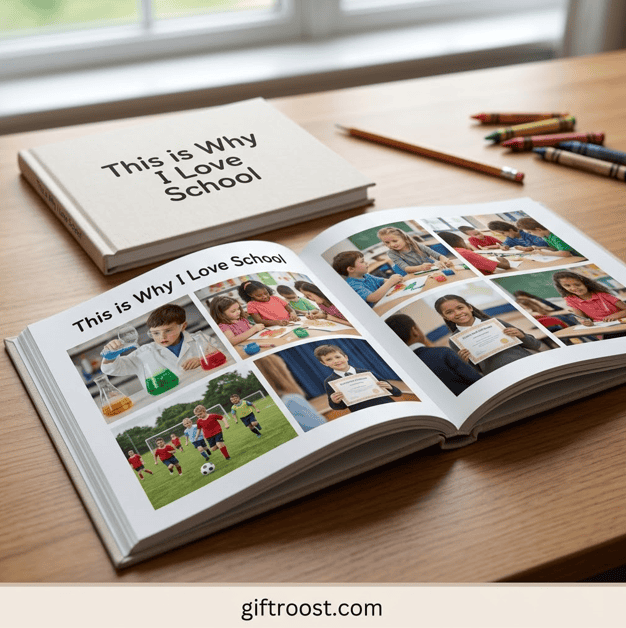
12. A “This is Why I Love School” Photo Book
This is the bigger project — the one for a special teacher at the end of a truly significant year, or for the parent who wants to put a little more time into something that will genuinely last. It requires some advance planning, a phone or camera, and a willingness to involve your child in the curation process.
Over the two or three weeks before Teacher Appreciation, photograph your child doing the things they love about school: reading at home the book they borrowed from the classroom library, working on a project inspired by something the teacher taught them, showing off something they made, re-enacting something funny that happened in class. Add to this any photographs you already have from school events, field trips, or moments from the school year.
Then, together with your child, create a small photo book using a service like Chatbooks, Snapfish, or even a drugstore photo printing service. Keep it simple — ten to fifteen pages, one photo per page, a caption written in your child’s words. The cover says: “This is why I love school.” Inside, each image has a small caption that your child has dictated: “This is the book Miss Torres read to us that made me love reading.” “This is the volcano experiment that blew my mind.” “This is me being brave enough to read out loud.” “This is the day I finally understood fractions.”
The teacher is not in every photograph. But she is present in all of them — in every skill learned, every confidence built, every moment of discovery captured. She will understand that immediately, and it will mean more than a photo of her face ever could. You’re not just showing her what the year looked like. You’re showing her what the year did.
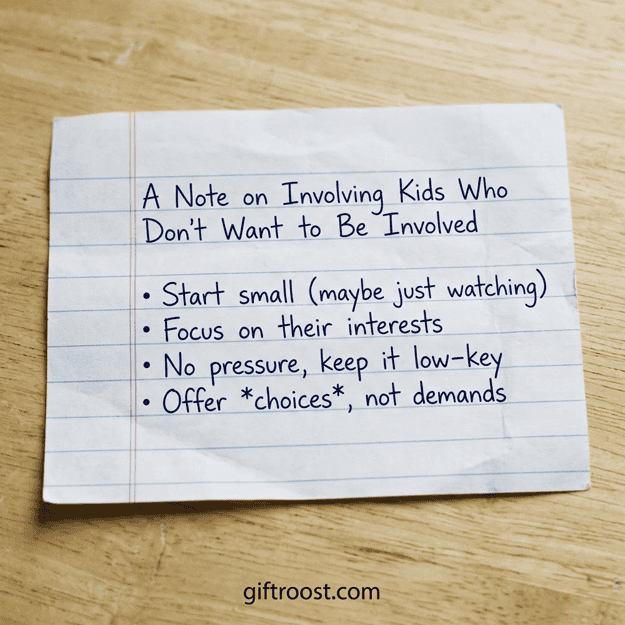
A Note on Involving Kids Who Don’t Want to Be Involved
Some children are enthusiastic about making gifts. They will want to paint every surface and add more glitter and redo the card three times because the first one wasn’t quite right. These children are a joy to make things with and will need mostly just supplies and supervision.
Other children are not interested. They are tired from school. They don’t understand why they have to make something. They want to go play. This is also a completely normal child.
My suggestion for the reluctant maker: find the smallest possible point of involvement that is still genuinely theirs. Maybe they don’t paint the pot, but they choose the color. Maybe they don’t write the card, but they dictate one sentence and you write it for them. Maybe they don’t assemble the gift, but they put the bow on and carry it to the car. That small thing is still their contribution. It still counts. The goal is not a perfect handmade object — the goal is a child who has some ownership over a gesture of gratitude toward someone who has invested in them.
Even a child who seems entirely uninterested in the process will often light up when their teacher actually receives the gift. That moment of “my teacher loves the thing I made” is formative in ways that aren’t immediately visible. It teaches a child that their effort has value. That their hands can make someone happy. That paying attention to another person — and showing it — is a skill worth having.
That’s worth a slightly reluctant afternoon at the craft table.
What to Write in the Card — Because the Card Matters More Than the Gift
I want to spend a moment on this because I genuinely believe the note is the most important part of any teacher appreciation gift, handmade or otherwise. A beautiful gift with a generic card is forgettable. A simple gift with a note that says something real — something specific, something that shows the teacher she was seen and that her work landed — is something she will keep.
Don’t write “Thank you for being a great teacher.” Write what you have actually observed. “Thank you for noticing when Lily was struggling with reading and staying with her until it clicked. I want you to know she reads for fun now, and that started in your classroom.” “Thank you for the way you spoke to Marcus when he was having a hard time. He came home that day and told me what you said, and he’s been repeating it to himself ever since.” “Thank you for seeing my child — not just the student, but the whole person.”
Specificity is what separates a meaningful note from a polite one. Teachers get many polite notes. They carry the specific ones home and re-read them when the work is hard and they’re wondering why they keep doing it. Your specific note might be the one that keeps a good teacher in the classroom instead of burning out and leaving. That is not an exaggeration.
Let your child add their own line, in their own words and handwriting, before your more articulate adult paragraph. Put theirs first. Let it be imperfect. It is the most important part.

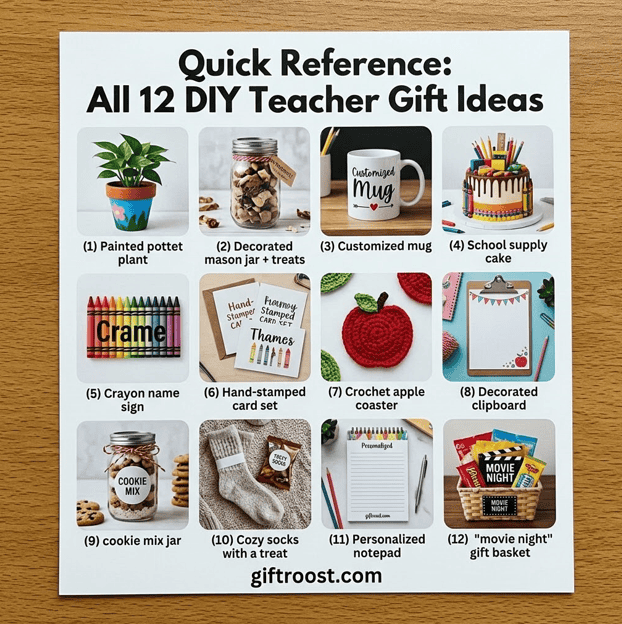
Quick Reference: All 12 DIY Teacher Gift Ideas
1. The “You Helped Me Grow” Herb Planter — A child-painted terracotta pot with a living herb plant and a personal message tag.
2. Hand-Stamped Tote Bag — A plain canvas bag decorated by your child with fabric paint, stamps, and handprints.
3. A “Things I Love About You” Jar — A decorated glass jar filled with slips of paper bearing your child’s honest observations and appreciations.
4. Handprint Keepsake Artwork — A framed handprint painting incorporating a meaningful message, capturing a moment in time.
5. Baked Treats, Beautifully Packaged — Something made in the kitchen with your child, presented with handmade packaging and a personal note.
6. A “Book About My Teacher” Mini Booklet — A hand-illustrated booklet filled with your child’s answers to prompts about their teacher.
7. A Seed Packet Garden Gift Set — Seed packets and a small pot assembled into a gift representing growth, care, and new beginnings.
8. A Class Photo Memory Frame — A meaningful photograph in a frame your child has decorated, preserving the year.
9. A Homemade Self-Care Gift Set — Simple relaxation items labeled and assembled by your child, with a heartfelt note acknowledging the teacher’s hard work.
10. A Personalized Tin Can Pencil Holder — A repurposed tin can covered in your child’s artwork and filled with colorful pens.
11. A Teacher Appreciation Coupon Book — A booklet of sweet “redeemable” offers decided entirely by your child.
12. A “This is Why I Love School” Photo Book — A printed photo book curated with your child showing what the school year meant, in their own words.
My daughter Lily is in fourth grade now. Miss Harmon — the teacher who received that wobbly-striped herb planter three years ago — still teaches second grade at their school. Lily saw her in the hallway last month and Miss Harmon called out: “Lily! My herb plant is still alive. I’ve been talking to it.”
Lily beamed all the way home.
That’s what a handmade gift from a child does. It sticks. It lives on a desk and gets watered and talked to and remembered. It outlasts the school year and the grade and sometimes even the school itself. It becomes a small story that a teacher tells, proof that what she does matters to the small people she does it for.
Give your child’s teacher something she’ll still be talking about three years from now. Let your child’s hands make it. That’s all it takes.
Save this to your Pinterest boards for Teacher Appreciation Week and share it with other parents who are still figuring out what to make. And if your child creates something from this list, I’d love to see it — drop a photo or a comment below. These small handmade moments are worth celebrating.
Read More : Mother’s Day Gifts from Daughter That Are Extra Special